A multi-agent swarm
that proves its work
Glaux turns a goal into a team of agents that plan, execute in parallel, and verify each other — then signs every step onto a tamper-evident ledger. It writes its own tools when none exist, and improves itself without being able to get worse.
Quickstart
Running in three commands
No API key required — Glaux runs fully local on Ollama, or against 30+ hosted providers.
# clone, build the native ledger kernel + dashboard
git clone https://github.com/aniketshukla1/glaux && cd glaux
./install.sh

# start the swarm → http://127.0.0.1:8000
./venv/bin/glaux up

# or drive it straight from the terminal
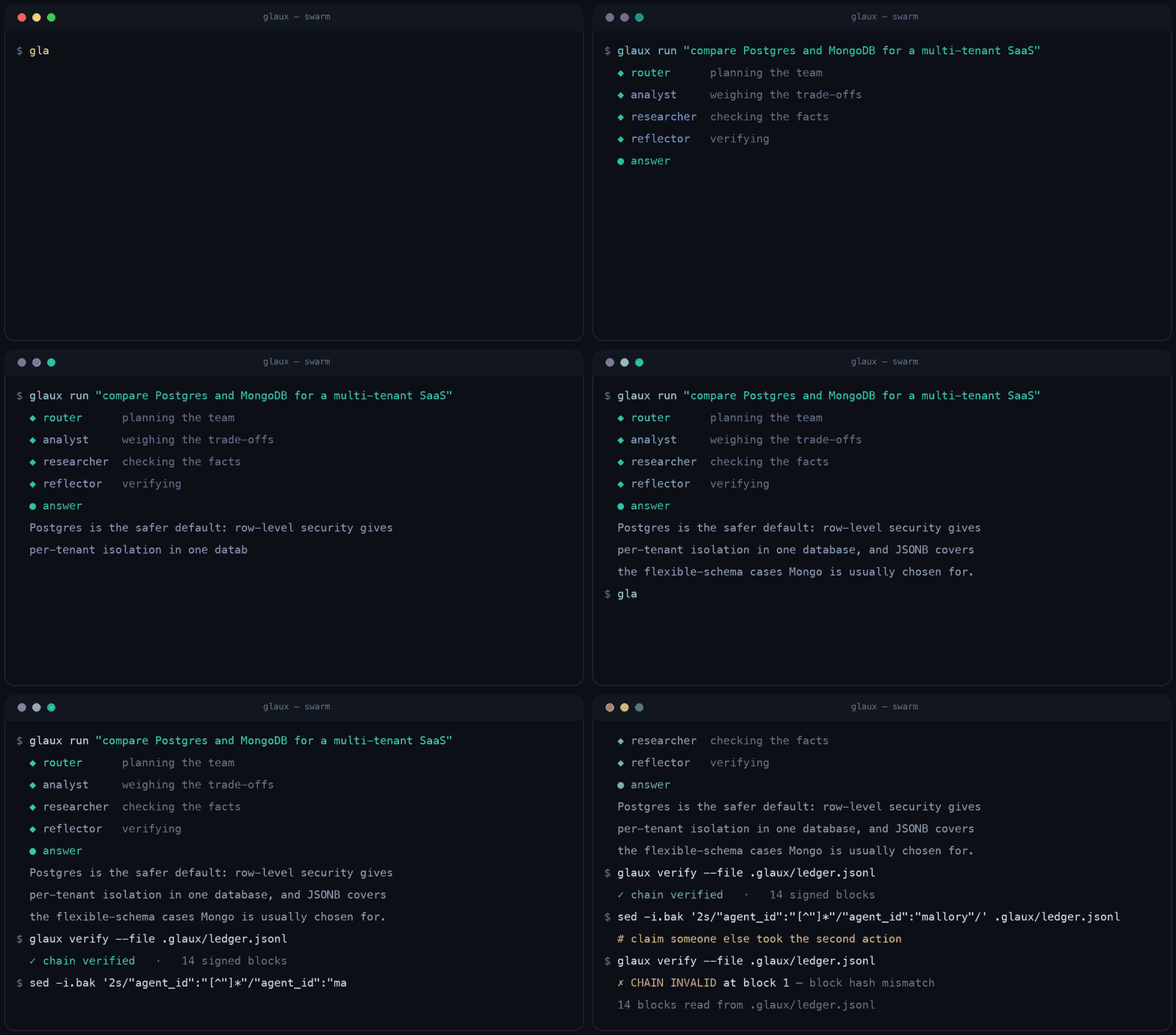
glaux run "research the top vector databases and write a comparison"
glaux verify   # ✓ chain verified · every step signed
Why Glaux
What makes it different
Most frameworks give you orchestration and observability. Glaux adds two things they structurally don't have — provable provenance and genuine self-extension — and makes both safe by construction.
It proves its work
Every action is Ed25519-signed by the agent that took it and appended to a hash-chained ledger. Tamper with a block and the chain breaks. Tracing tells you what a system claims it did; a signed chain lets you prove it.
It builds its own tools
When nothing fits, an agent writes a skill. Glaux static-capability-checks it, runs its generated tests in the sandbox, and injects it into the live run. Proven skills get promoted; failing ones get repaired and retried.
It can't get worse
The harness tunes its own routing, budgets, prompts, playbooks and tool library from outcomes. Every self-modification is evidence-gated, signed to the ledger, and reversible.
It doesn't overpay
A sub-millisecond embedding router sends trivial asks to a one-shot responder and only escalates real work to the full swarm — and it learns from mis-routed runs. An opt-in semantic cache answers repeats with zero model calls.
Capability-zero sandbox
Model-written code runs in a WebAssembly guest with no ambient authority — it cannot syscall by default. File access is a separate, opt-in jailed workspace with size caps.
Yours, and local
Runs entirely offline on Ollama with a native Rust core. No vendor lock-in, no telemetry, Apache-2.0 licensed. Drive it from a dashboard, a full-parity CLI, or the HTTP API.
| Glaux | Typical agent framework | |
|---|---|---|
| Audit trail | Signed, hash-chained ledger | Tracing / logs |
| New tools | Synthesized + sandbox-tested at runtime | Pre-registered by you |
| Self-improvement | Gated, signed, reversible | Manual tuning |
| Cost control | Learned tiering + semantic cache | Usually one model per call |
| Isolation | WASM, zero ambient authority | Often “enforce at the tool level” |
The console
Built around the proof
Every answer shows who worked on it and how many steps were signed. One click takes you to the chain itself, with the command to check it offline, without trusting this app.
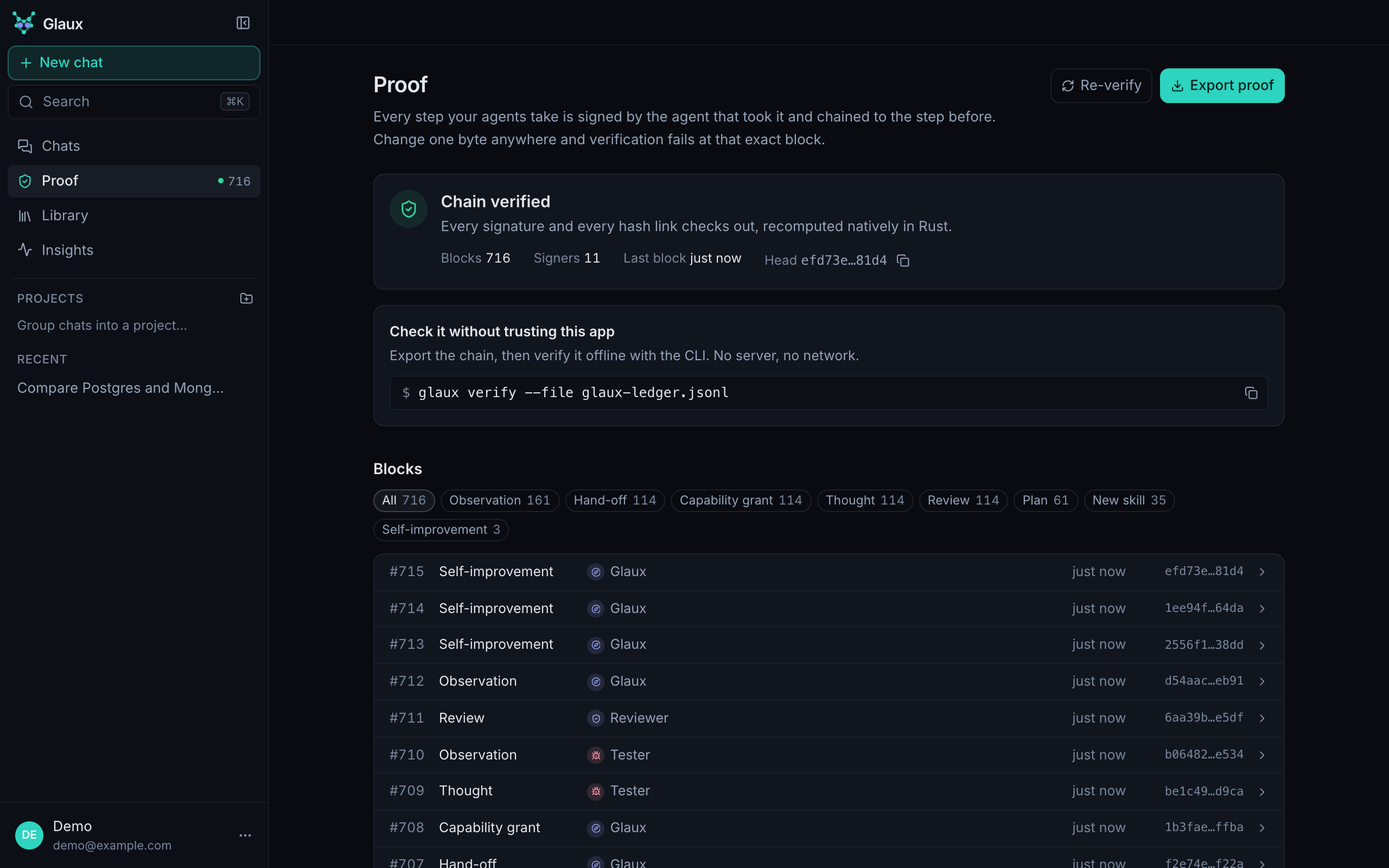
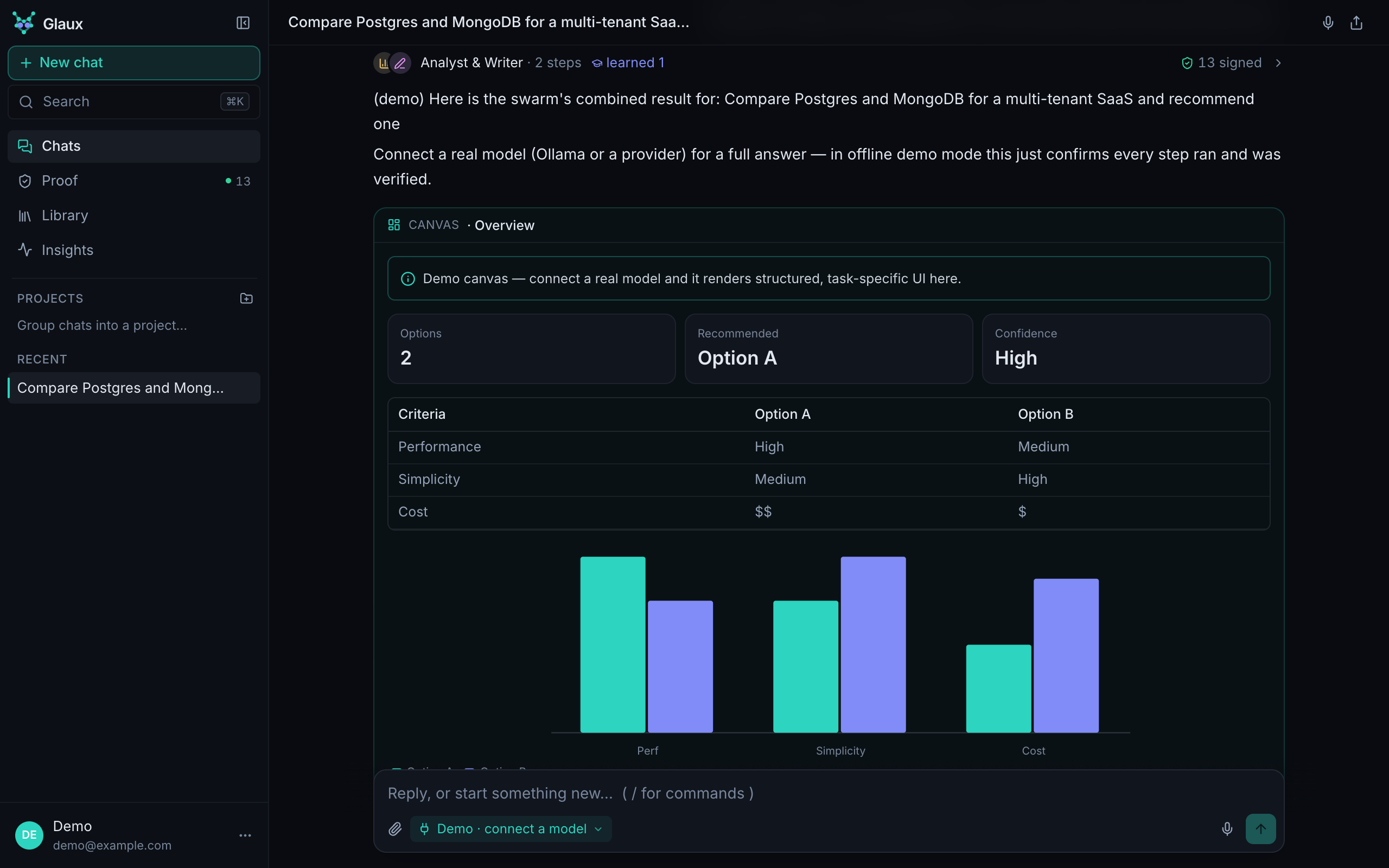
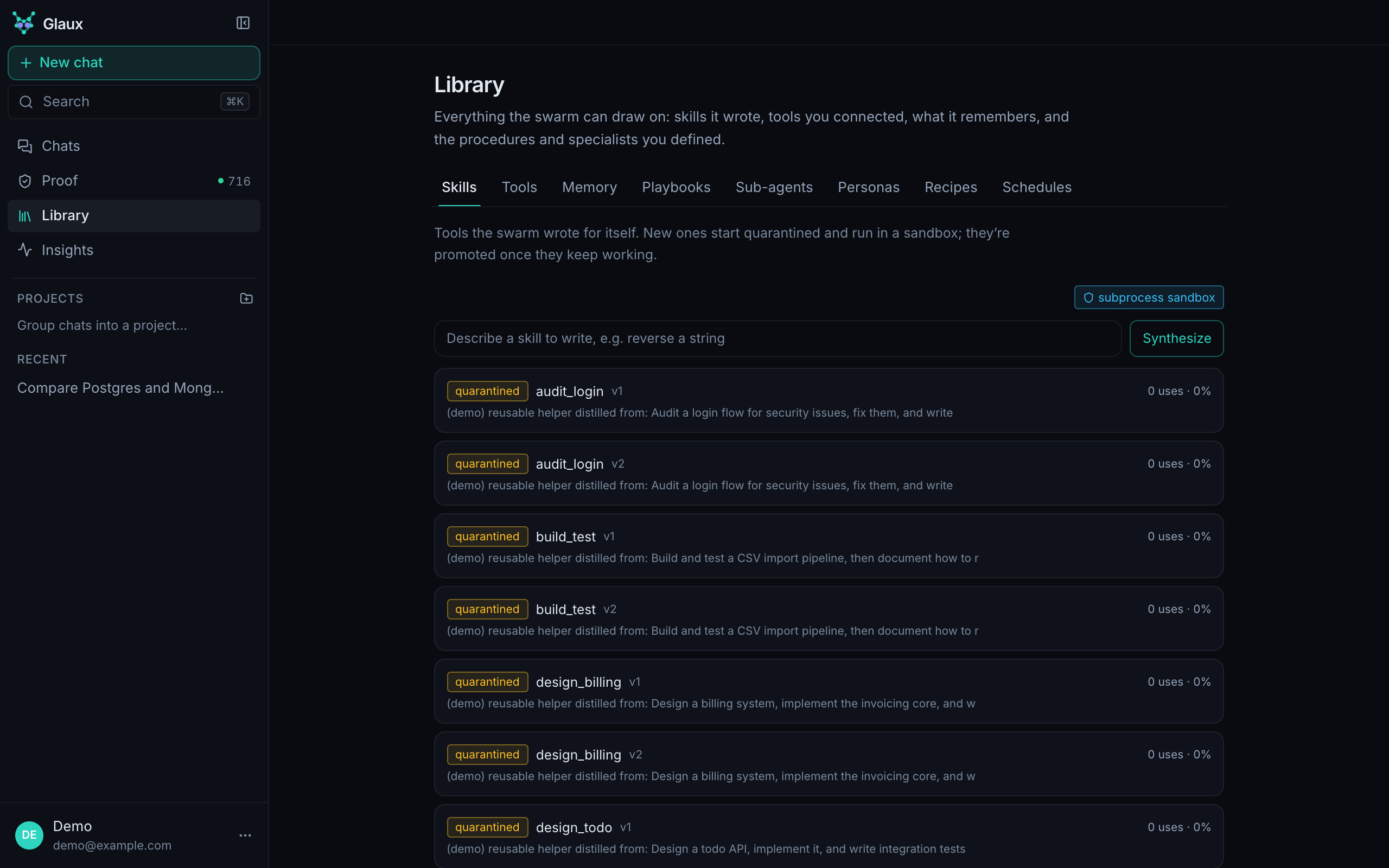
Screenshots from the built-in demo mode: no model connected, answers simulated, signatures real.
The self-evolving harness
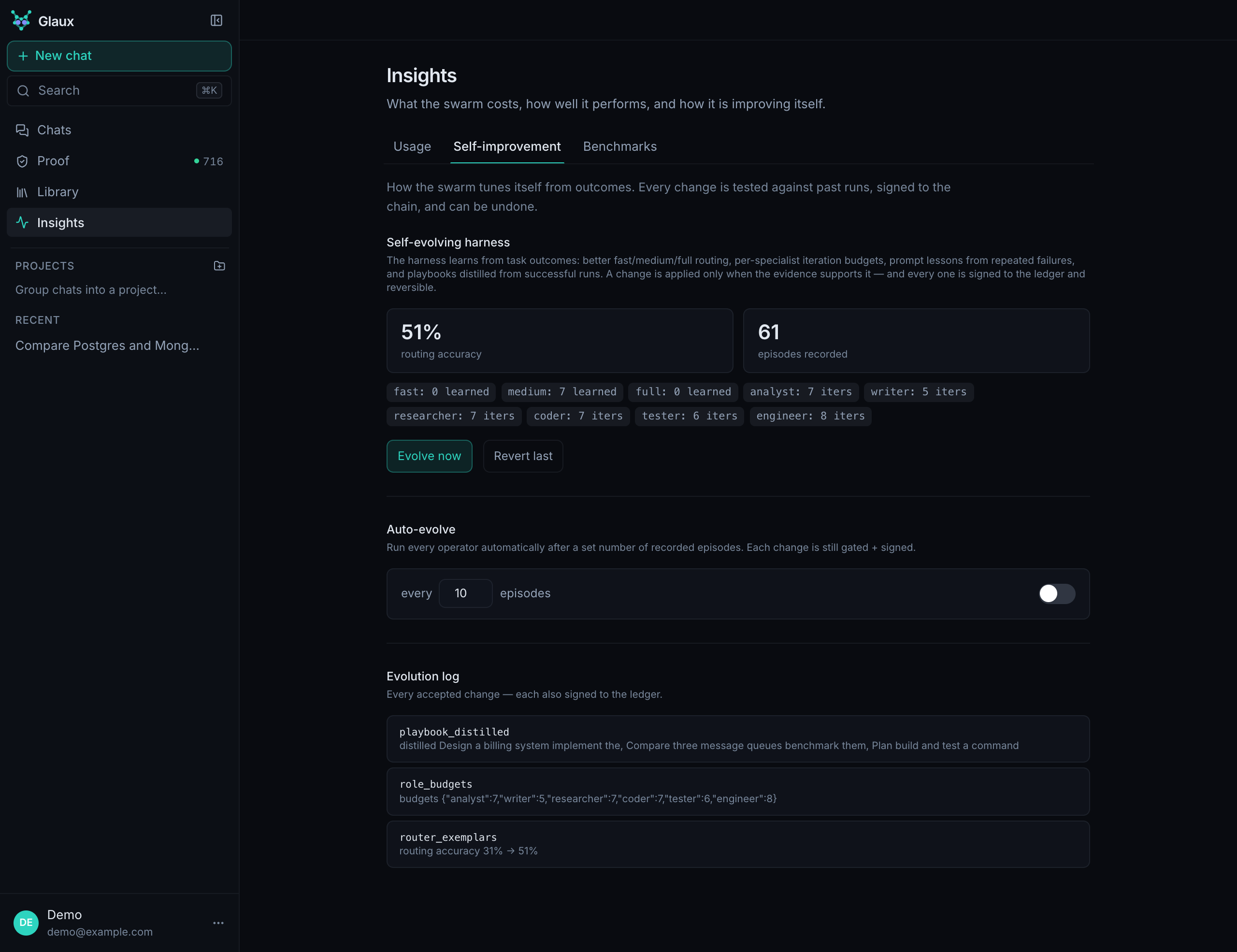
It improves itself — and can prove it
The harness learns from task outcomes: better routing, per-specialist budgets, prompt lessons, distilled playbooks, and promoting proven tools. In the demo run shown here, it lifted its own routing accuracy from 31% to 51% over 61 episodes.
- Gated — applied only when the evidence supports it
- Signed — written to the ledger as EVOLVE_HARNESS
- Reversible — one command undoes it